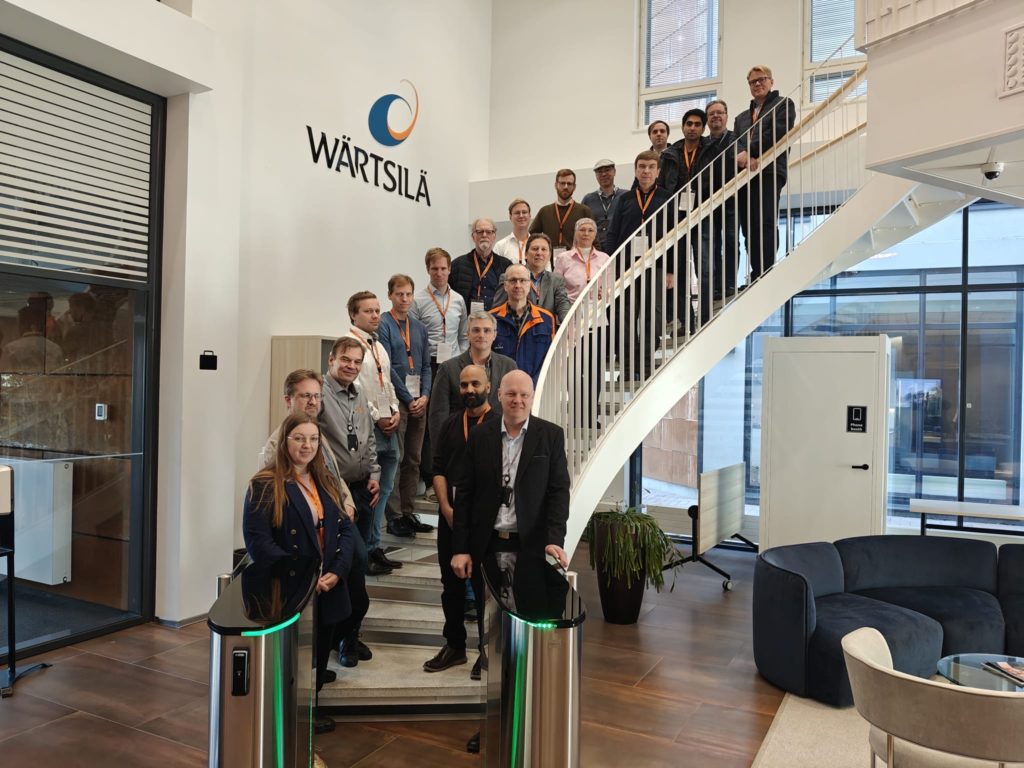
The MaritimeMET project held its mid-term meeting on April 15 and 16 at the facilities of its partner, Wärtsilä, in Vaasa, Finland. On the first day, the work package (WP) leaders provided updates on each WP. On the second day, several project speakers presented the latest developments to external stakeholders in the “MaritimeMET Workshop: Role of Metrology for Greener Shipping”, and external experts conducting research in green shipping were also invited.
The meeting began on April 15 with a full-day session focused on presenting the project’s progress across the technical work packages and discussing the challenges to be addressed during the second phase of the project. The presentations covered the main research lines being developed within MaritimeMET, including traceable emission measurements (WP1), dynamic measurements of in-cylinder pressure and temperature (WP2), and machine learning approaches for performance optimisation and the development of virtual sensor concepts (WP3). The day concluded with a visit to the Wärtsilä Sustainable Technology Hub laboratories, where the project partners were able to see firsthand some of the initiatives that are carried out by Wärtsilä.
On April 16, the consortium welcomed 40 participants (20 online and 20 in person) to its Mid-Term Stakeholder Workshop, a knowledge-exchange forum that enabled interaction between MaritimeMET partners and other stakeholders in the maritime decarbonisation sector. The workshop was structured into three blocks, each focusing on one of the project’s main research areas.
Before the first block, Anders Öster, General Manager of Research Coordination & Funding at Wärtsilä, delivered an overview of the project, explaining how MaritimeMET will contribute to achieving zero emissions in the maritime sector. This was followed by Arpit Malik, Researcher at the German National Metrology Institute (PTB), who opened the WP1 session by presenting the work carried out to assess the current state of particulate emissions from green ship engines. In addition, Jan Petersen, Senior Scientist at Danish National Metrology Institute introduced the work on Photoacoustic Spectroscopy (PAS) and Wavelength Modulation Spectroscopy (WMS) sensors, aimed at enabling traceable measurements linked to optical gas standards.
The session then continued with presentations from MaritimeMET partners on WP2. Eynas Amer, Senior Researcher at the Research Institutes of Sweden, presented progress towards traceable dynamic pressure calibration using shock tube methods. Next, Richard Högström, Research Team Leader at VTT-MIKES, and Yasin Durgut, Institute Director at the Turkish National Metrology Institute, delivered a joint presentation on the development of primary dynamic pressure standards for calibrating cylinder pressure sensors. This was followed by Alexander Fateev, Senior Scientist at the Technical University of Denmark, who addressed the research carried out on dynamic temperature measurements for industrial applications.
Finally, Joachim Jaensch, Researcher at the Technical University of Braunschweig (Germany), presented updates on the modelling of methanol dual-fuel combustion and emissions formation, combining kinetic mechanisms and machine learning techniques to enhance predictive capabilities.
In addition to the contributions from MaritimeMET partners, the workshop featured three invited speakers who presented their work aligned with the project’s research lines. Lars Bo Andersen, Head of Test Centre & Technology Development at Alfa Laval (Denmark), presented strategies for safely testing renewable fuels and their blends in open combustion systems. Subsequently, Leon Korr, Junior Project Manager at Kistler, presented work on pressure pulse calibration. Finally, Bernhard Geiger, Associate Professor at the Graz University of Technology, introduced approaches to improving data-driven systems using differential equations, highlighting open challenges in integrating physical models with machine learning techniques.
This exchange of knowledge between MaritimeMET and related research in green maritime shipping fostered meaningful interaction. Through these evidence-based discussions, the industry gains a clearer understanding of the steps needed to reduce emissions in the maritime sector and move towards net-zero targets—an essential step in addressing climate change. The MaritimeMET consortium would like to thank all speakers and participants for their time and valuable contributions. For those interested in learning more about the topics covered, the workshop presentations are available below.
STRATEGIES FOR TESTING RENEWABLE FUELS & BLENDS SAFELY IN AN OPEN COMBUSTION SYSTEM
MEASURING PARTICULATE EMISSIONS FROM GREEN SHIP ENGINES: STATE OF THE ART AND CALIBRATION RESULTS
DEVELOPMENT OF PAS- AND WMS-BASED SENSORS, TRACEABLE TO OPTICAL GAS STANDARDS
PRESSURE PULSE CALIBRATION
DYNAMIC PRESSURE PRIMARY STANDARDS FOR CALIBRATING CYLINDER PRESSURE SENSORS
DYNAMICAL TEMPERATURE MEASUREMENTS FOR INDUSTRIAL APPLICATIONS
IMPROVING DATA-DRIVEN SYSTEMS WITH DIFFERENTIAL EQUATIONS – APPROACHES AND OPEN PROBLEMS
MODELLING OF MEOH DUAL-FUEL COMBUSTION AND EMISSIONS FORMATION-USING KINETIC MECHANISMS AND MACHINE LEARNING APPROACH
TOWARDS TRACEABLE DYNAMIC PRESSURE CALIBRATION USING SHOCK TUBE METHOD