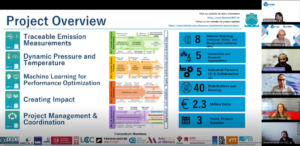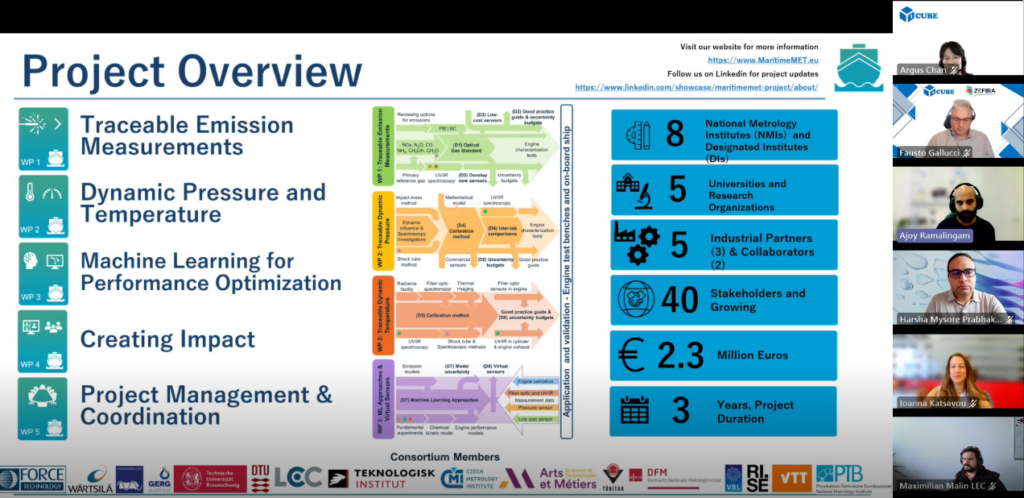
MaritimeMET participated in the Virtual Tech Forum “From Policy to Practice: Powering Maritime Excellence” webinar, organised by 1 Cube BV on the occasion of the International Maritime Organization’s World Maritime Day last Wednesday, September 24. Ajoy Ramalingam, Postdoctoral Researcher at the German National Metrology Institute presented the project’s approach to metrology for green maritime shipping, highlighting the role of reliable and traceable measurements in supporting the maritime energy transition.
During the webinar, Ramalingam outlined the main lines of action of MaritimeMET, focusing on developing the metrological tools needed to support greener maritime shipping through traceable emission measurements and machine-learning approaches. He explained how the project aims to help engine manufacturers better understand both engine performance and emissions when using greener fuels, developing reliable methods to measure emissions at low trace levels, dynamic pressure and temperature inside the combustion process, and data-driven models that can help optimise engine performance and reduce emissions.
Then, a roundtable was organised with experts from other European research and innovation projects to discuss how Europe can translate maritime policies, decarbonisation ambitions and technological objectives into practical solutions and deployment. The panel featured Fausto Gallucci, Senior Consultant at 1 Cube BV (APOLO); George Skevis, General Manager at CLEOS (CAIPIRINH3A), and Harsha Mysore, Innovation Consultant at BlueXPRT (Green Marine). In addition, Ramalingam also represented the MetNH3Energy project.
The roundtable focused on how research and policy can translate into practical solutions for maritime decarbonisation. In this case, the discussion around MaritimeMET highlighted the importance of reliable measurement capabilities in tackling this issue. Participants discussed the challenges of monitoring emissions from alternative-fuel engines, the role of measurement data in demonstrating compliance with future regulations, and the need to build confidence in new technologies through accurate and traceable measurements.
MaritimeMET’s focus on traceable measurements, emission monitoring and improved engine performance directly supports the implementation of cleaner and more efficient maritime technologies. In this sense, the project has aligned with the World Maritime Day by helping translate decarbonisation objectives into measurement capabilities and practical tools for the maritime sector.