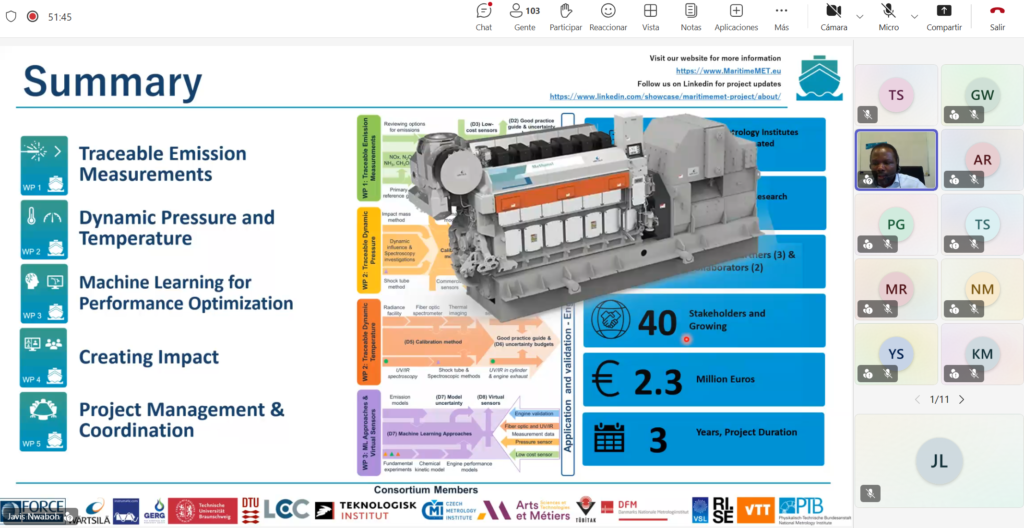
MaritimeMET co-hosted a joint online workshop alongside the MetZeroPol and MetNH3Energy projects to discuss sector-specific approaches to emission monitoring last on 30 September 2026. MaritimeMET presented its work on laser spectroscopic methods to characterise low-cost sensors, highlighting the importance of reliable measurement technologies for monitoring emissions and supporting the development of cleaner solutions in the maritime sector.
Javis Nwaboh, Research Scientist at the German National Metrology Institute, focused on MaritimeMET’s work to characterise low-cost sensors using laser spectroscopic methods. The presentation addressed a key aspect of emission monitoring: developing and assessing measurement technologies that support reliable monitoring approaches.
Then, MaritimeMET welcomed two guests representing the industry perspective. Sotiris Topaloglou, Deputy VP R&D and Global Head of Testing & Validation at WinGD Ltd, and Gabrielle Pisetta, Test Engineer also at WinGD Ltd. Both opened a debate around the engine manufacturer’s perspective on emissions associated with methanol and ammonia alternative fuels.
Regarding the MetZeroPol project, Christian Vogel, Senior Scientist at the German Federal Institute for Materials Research and Testing, addressed the metrological analysis of PFAS (per- and polyfluoroalkyl substances) in industrial emissions, illustrating how measurement science can respond to complex and emerging emission-monitoring challenges. The programme was further complemented by guest speaker Lighea Speziale, Founding Partner and Project Leader at Seeds Consulting, who presented the impact of the revised regulatory framework and BAT (Best Available Techniques) Conclusions on industrial emissions.
After, it was the turn for MetNH3Energy project. Alexander Fateev, Senior Scientist in the Department of Chemical and Biochemical Engineering at the Technical University of Denmark (DTU), explored the project’s focus on ammonia-based fuel combustion at industrial scale. Then, Julian Edler, Development Engineer at the Innovation Lab of Endress+Hauser SICK GmbH+Co.KG (guest speaker of MetNH3Energy), focused on his research on technology selection to monitor nitric oxide, nitrogen dioxide, and ammonia.
The workshop highlighted the fundamental role of metrology in reliable emission monitoring. Accurate, traceable and fit-for-purpose measurements provide the evidence needed to understand emissions, evaluate new fuels and technologies, assess regulatory compliance and support informed environmental decisions. From low-cost sensor characterisation and the monitoring of trace gases to the analysis of emerging pollutants and emissions from alternative fuels, metrology can help turn technological innovation into reliable data and contribute to the transition towards cleaner and more sustainable maritime and industrial systems.
The slide deck and the webinar recording will be available soon.